Introduction: A Night Outside Church That Ended in Tragedy Two boys stepped off the sidewalk outside a church in Winter Haven, Florida. They waited for a truck heading southbound to pass. Then they crossed north — and were struck by a driver traveling the opposite direction who never slowed down, never stopped, and never looked back.
The 8-year-old died on impact. The 10-year-old was rushed to Arnold Palmer Hospital with a broken arm, a broken femur, and a compound skull fracture. The driver sped away.
What followed was a case that has left the country horrified — not only because of the crime itself, but because of how the driver, 30-year-old Victoria Johnson of Winter Haven, behaved afterward. According to reports from her arrest, Johnson laughed as she was charged. She gave deputies three conflicting stories. She called the Sheriff’s Office the next morning to falsely report her vehicle stolen. And investigators say she admitted she had smoked methamphetamine before getting behind the wheel — with a license already suspended from a prior DUI.
This is the full story of what happened on the night of March 11, 2026 — and what it tells us about the catastrophic, irreversible consequences of drug-impaired driving.
What Happened: The Winter Haven Hit-and-Run
The Crash Outside Faith Baptist Church
The incident unfolded at 8:25 p.m. on March 11, 2026. The Polk County Sheriff’s Office received 911 calls from Faith Baptist Church on Crystal Beach Road at Winter Lake Road in Winter Haven regarding two children who had been struck by an unknown vehicle that immediately fled the scene.
The boys had been attending a church function that evening. They had crossed to the west side of Crystal Beach Road when they were called back. They waited for a southbound truck to pass — then walked into the road. At that moment, investigators say Victoria Johnson’s dark blue 2009 Hyundai Santa Fe, traveling northbound, struck them without stopping.
The 8-year-old was killed on impact. His 10-year-old companion was rushed to Arnold Palmer Hospital, where he was treated for a broken arm, a broken femur, and a compound skull fracture — injuries so severe that he required emergency intervention. A church member told FOX 13 that the church pastor’s 50th birthday celebration was taking place after the Wednesday evening service, and the kids were going across the street as part of that event.
Johnson Fled — Then Tried to Cover Her Tracks
After the collision, Johnson did not stop. She did not call for help. She drove away.
What came next was a calculated attempt to escape accountability. The break in the case came the following morning — but not in the way investigators expected. Johnson herself called the Polk County Sheriff’s Office to report her own vehicle stolen, claiming she had loaned it to someone who never brought it back.
When deputies arrived at her home to investigate the stolen vehicle report, she was already gone.
Arrest records show Johnson gave investigators three entirely contradictory stories over the course of questioning: first that her car was stolen, then that she had loaned it to someone who never returned it, and finally that she had handed it to a man named Corey Stewart specifically to “get rid of it.”
While Johnson was being transported to a substation for questioning, deputies spotted her damaged Hyundai on State Road 60 in Lake Wales. The driver — Stewart — and his passenger, Mya Bass, led deputies on a brief pursuit before barricading themselves inside a nearby home. Both were eventually taken into custody and charged with resisting arrest, possession of methamphetamine, possession of marijuana, and possession of drug paraphernalia.
The Meth Admission: What Johnson Told Investigators
A Regular User Behind the Wheel
When investigators questioned Johnson, the admission was direct and damning. She told deputies that she is a regular methamphetamine user and had used the drug before driving her vehicle on the night of March 11, 2026.
According to the arrest affidavit, Johnson said she had been driving around for roughly 20 minutes before the crash, listening to music and trying to relax — even though she knew her license had been suspended following a prior DUI arrest by Winter Haven police in November 2025.
After the crash, she met Stewart at a nearby Circle K convenience store, moved to the passenger seat and let him take the wheel. They then went to a house where they used methamphetamine again, then drove to a pond to go fishing before Stewart eventually took Johnson home and left with her car.
The affidavit noted that Johnson “stated several times that she knew she was in trouble and would be going to jail.”
A Prior DUI on Her Record
Johnson’s criminal history added another layer to the case. Investigators confirmed that her driver’s license was suspended specifically because of a DUI arrest by Winter Haven police in November 2025 — just four months before the crash that killed the 8-year-old boy.
Not only had she already demonstrated she was willing to drive impaired — she had already faced legal consequences for it. Those consequences did nothing to stop her from getting behind the wheel again, this time on methamphetamine, this time without a license, and this time with fatal results.
At Johnson’s first appearance before a judge, the court found probable cause that she was violating the terms of her probation from the November DUI. She is being held without bond.
The Charges Victoria Johnson Faces
Johnson was arrested on March 12, 2026 — less than 24 hours after the crash. She faces the following charges:
- Leaving the scene of a crash with death (Felony 1)
- Leaving the scene of a crash with serious bodily injury (Felony 2)
- Tampering with evidence (Felony 3)
- Driving without a license causing death (Felony 3)
- Giving false information to law enforcement (Misdemeanor 1)
The first-degree felony charge — leaving the scene of a crash resulting in death — carries a maximum sentence of 30 years in Florida state prison. Additional charges may follow as the forensic examination of the vehicle and Johnson’s cell phone is completed.
The Laughing: What It Tells Us
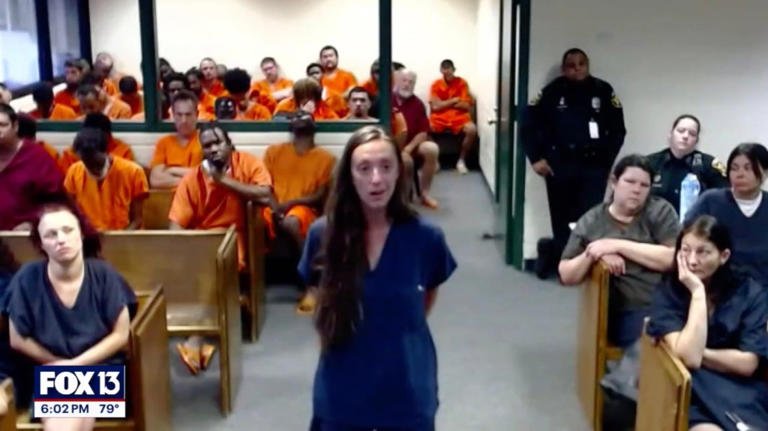
Reports from the arrest indicate that Johnson laughed as she was being charged — a detail that has struck many following this case as incomprehensible, and that has drawn widespread outrage.
Methamphetamine is a powerful central nervous system stimulant that dramatically alters a user’s emotional responses, judgment, and perception of reality. At the neurological level, acute meth intoxication floods the brain with dopamine, producing euphoria and, in many users, disinhibition — the removal of the normal social and emotional brakes that govern behavior.
This does not explain the behavior. It does not excuse it. But it does provide critical context for how a person could respond with laughter when confronted with the consequences of a child’s death. The drug does not simply impair driving — it can fundamentally alter a person’s capacity for empathy, remorse, and appropriate emotional response.
The laughing in this case is a stark illustration of exactly why driving under the influence of methamphetamine is so catastrophically dangerous — and why the legal system treats it with such severity.
The Devastation Methamphetamine Causes on the Road
What Meth Does to a Driver
Methamphetamine creates a deceptive illusion of capability. Users often feel more alert, more focused, and more in control — even as their actual ability to operate a vehicle safely deteriorates sharply. The specific impairments caused by meth use include:
- Distorted perception of speed and distance — drivers routinely misjudge how fast they are moving and how far away objects are
- Tunnel vision and reduced peripheral awareness — reducing the ability to see pedestrians, cyclists, or cross-traffic
- Aggressive and erratic behavior — meth significantly increases impulsive decision-making
- Hallucinations and paranoia — particularly in users with patterns of regular use
- Dramatically slowed reaction times — despite the subjective feeling of being “sharp”
The 8-year-old boy and his 10-year-old friend were in a clear location, at a church, in the evening. Johnson had approximately 20 minutes of driving during which nothing happened — until it did. Methamphetamine does not give a driver warnings. It simply removes the ability to respond in time.
The Scale of the Problem in Florida
Drug-impaired driving is a growing crisis in Florida. According to the Florida Department of Highway Safety and Motor Vehicles, drug-impaired driving fatalities have increased significantly over the past decade, with stimulants like methamphetamine representing a growing proportion of those cases. Florida ranks among the top states nationally for drug-impaired driving fatalities.
Cases like this one are not statistical outliers. They are the predictable result of a pattern: an impaired driver on a public road, a victim who had no way of knowing the danger they were in, and a system that did not remove the threat before tragedy struck.
What Families and Communities Can Do
This case is a call to action — not just for law enforcement, but for communities, families, and anyone who knows someone struggling with addiction.
1. Report Impaired Drivers Immediately
If you see a driver who appears impaired — swerving, braking erratically, traveling at inconsistent speed, or behaving dangerously — call 911 immediately. Do not follow the vehicle. Pull over safely and provide the best description you can of the vehicle, its location, and the direction of travel. Your call could save a life.
2. Know the Signs of Methamphetamine Use
If someone you know is using methamphetamine, watch for these behavioral indicators:
- Sudden, severe weight loss over a short period
- Extreme mood swings — from euphoria to aggression
- Paranoia, anxiety, or hallucinations
- Prolonged wakefulness followed by extended sleep
- Deterioration of dental health (“meth mouth”)
- Social withdrawal and erratic decision-making
If you identify these signs, do not enable access to car keys. Remove them if necessary and seek immediate help.
3. Support Intervention and Treatment
Methamphetamine addiction is treatable. It is not a moral failing — it is a medical condition that requires medical intervention. If someone you love is using meth, contact SAMHSA’s National Helpline at 1-800-662-4357 (free, confidential, available 24/7) for treatment referrals and guidance.
4. Advocate for Stronger Impaired Driving Laws
Cases like Victoria Johnson’s — where a driver with a prior DUI conviction drove impaired again, with fatal consequences — expose gaps in how the legal system deters repeat offenders. Contact your state representatives to advocate for stricter mandatory sentencing for drug-impaired drivers, ignition interlock requirements, and expanded drug testing following DUI convictions.
5. Talk to Young People About Drug-Impaired Driving
The normalized narrative around impaired driving too often focuses only on alcohol. Methamphetamine, prescription opioids, cannabis, and other substances all impair driving dangerously. Make sure the young people in your life understand that “impaired” does not only mean drunk — and that there is no safe threshold for driving on meth.
Polk County Sheriff’s Response
Polk County Sheriff Grady Judd praised his department’s speed in making the arrest, noting investigators cracked the case in under 24 hours.
In a statement, Sheriff Judd said: “I am so very proud of my detectives and analysts — who are the very best in the business — for their tenacity and determination, which ultimately led to this suspect being taken into custody. Please keep these children’s families in your prayers.”
A preliminary search of the Hyundai revealed damage, missing parts, and what investigators described as “potential biological matter on the vehicle consistent with a pedestrian strike.” Deputies have obtained search warrants for both the vehicle and Johnson’s cell phone, and a complete forensic analysis is underway. Additional charges remain possible as that process continues.
Conclusion: A Community in Mourning, a Country Paying Attention
An 8-year-old boy crossed a street outside his church on a Wednesday evening to celebrate his pastor’s birthday. He did not come home.
The Florida driver charged with killing him while high on meth — with a suspended license, a prior DUI, and an apparent willingness to laugh about it — is now behind bars. The legal process will unfold. But for the family of the child who died, the 10-year-old still recovering in hospital, and the congregation of Faith Baptist Church in Winter Haven, no verdict will undo what happened on Crystal Beach Road on the night of March 11, 2026.
This case must be more than a news story. It must be a turning point — in how we treat drug-impaired driving, how we respond to addiction before it kills, and how seriously we take the responsibility that comes with getting behind the wheel.
If you know someone struggling with methamphetamine addiction, call SAMHSA’s free helpline now: 1-800-662-4357. If you witness impaired driving, call 911. The life you save may belong to an 8-year-old waiting to cross the street.