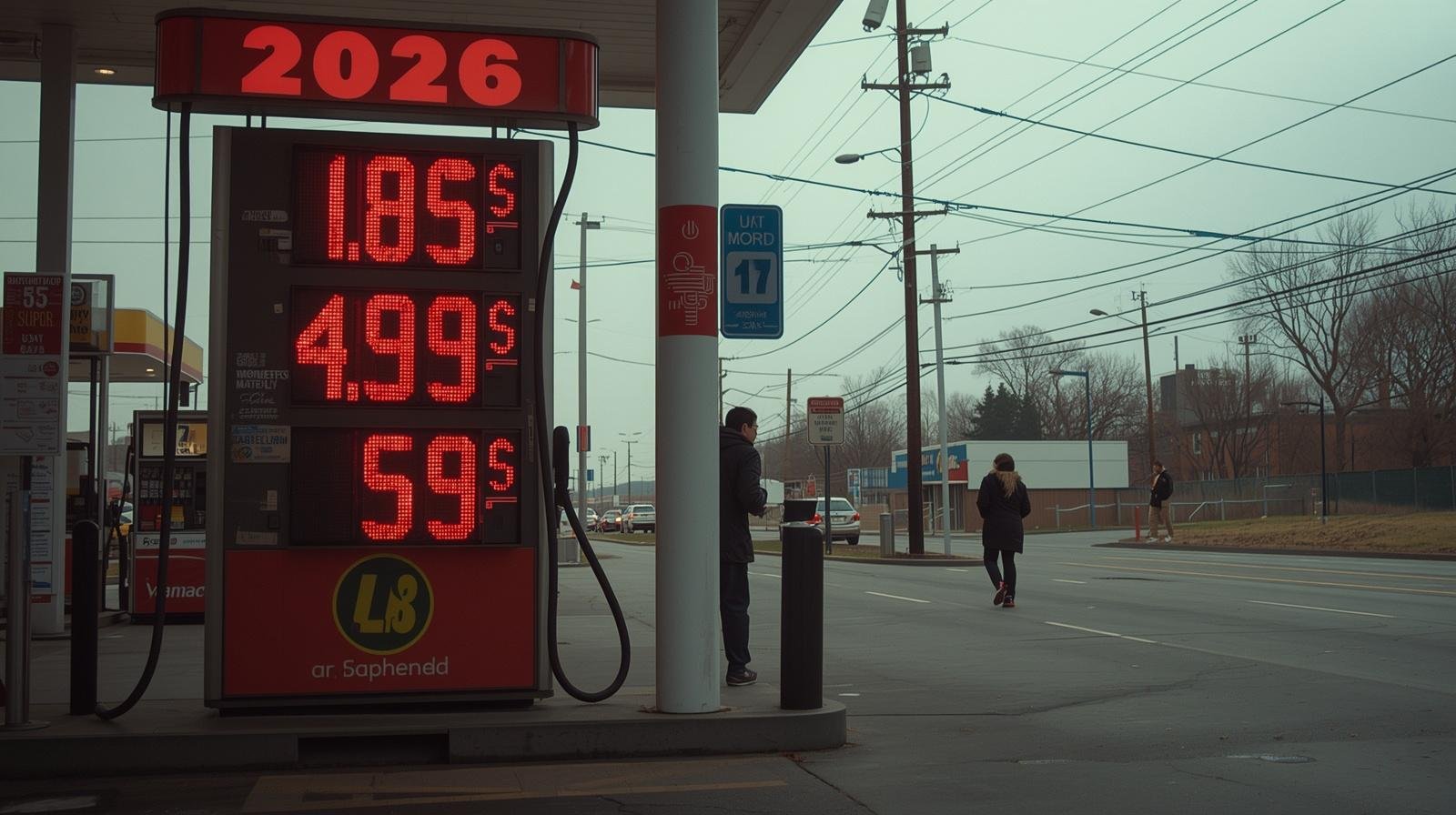
If you filled up your tank last month and felt a jolt of sticker shock this week, you are not imagining it. Gas prices across the USA have surged at a speed not seen since the COVID-era shocks of 2022, and every new day seems to bring a fresh record in some corner of the country.
The cause is real, the trajectory is steep, and the relief — according to the government’s own energy analysts — is not coming as fast as the White House would like you to believe.
Average fuel prices are now $3.84 a gallon, up 31% from a month ago. And it might be a long time before drivers see gas below $3 a gallon again, despite recent statements from the Trump administration claiming otherwise.
This is the full picture of gas prices in the USA in March 2026: what is happening, why it is happening, which states are hardest hit, what the government is — and isn’t — doing about it, and what you can do right now to protect your wallet.
What Is Happening to Gas Prices Right Now?
The Numbers in Real Time The speed of this price surge is extraordinary even by historical standards. Here is the timeline of the national average for a gallon of regular unleaded in just the past few weeks:
- March 5, 2026: The national average jumped nearly 27 cents in a single week to $3.25. CNN
- March 8, 2026: The national average reached $3.45 per gallon — a 16% jump in a single week. Encyclopedia Britannica
- March 12, 2026: The national average jumped nearly 35 cents in another single week. The White House
- March 14, 2026: The national average reached $3.67 per gallon as fresh strikes in the Persian Gulf hit three ships in the area. PBS
- As of this week: The national average stands at $3.84 per gallon — up 31% from just one month ago. euronews
That is a rise of roughly 60 cents per gallon in under three weeks. For a driver filling a 15-gallon tank, that is $9 more per fill-up than it cost in February. For a driver filling a 20-gallon SUV tank, it is $12 more — every single fill-up.
The All-Time Record Is Now in Reach
The all-time record national average gas price, per AAA, is $5.02 per gallon, set on June 14, 2022. If oil prices hold near current levels, that record is squarely in the crosshairs. Polymarket has 36% odds on gas prices hitting $5 by the end of March. Encyclopedia Britannica
A more than one-in-three chance of a new all-time high before March ends. That is not a fringe prediction — that is the market consensus on where gas prices in the USA are heading.
Why Are Gas Prices So High? The Real Reason Explained
The Iran War and the Strait of Hormuz
The single biggest driver of rising gas prices in the USA right now is the ongoing US-Israel war with Iran, which began on February 28, 2026 — and its effect on the world’s most critical oil artery.
Iran’s closure of the Strait of Hormuz has resulted in crude oil prices surging, with WTI crude oil prices spiking all the way up to $119 a barrel. At the start of 2025, WTI crude oil was just $57 per barrel. With more than 20% of the global oil supply halted, Americans are now feeling price pressures at the pump amidst the geopolitical uncertainty. NBC News
The Brent crude oil spot price settled at $94 per barrel on March 9, up about 50% from the beginning of the year and the highest since September 2023. Crude oil prices have risen as petroleum shipments through the Strait of Hormuz have fallen, and some Middle East oil production has been shut in. facebook
In plain terms: the waterway through which roughly one-fifth of the world’s oil travels has effectively been closed. When global oil supply drops that sharply, prices rise — and they rise at the pump within days.
Why Consumer Prices Lag the Oil Markets
What consumers pay at the pump generally lags financial markets. Encyclopedia Britannica This is one of the most important things to understand about the current gas price environment. When oil futures spike, it takes a few days to a week for that spike to fully translate into pump prices. That means the oil market jumps of March 8-14 are still working their way through the supply chain — and the prices you see today may not yet reflect the full extent of the crude oil surge.
Spring Demand Is Making It Worse
The Iran war hit at the worst possible seasonal moment. Spring Break season is here, and gasoline demand increased last week from 8.29 million barrels per day to 9.24 million. The White House Higher demand compounding a supply shock is a textbook recipe for accelerating price increases.
Total domestic gasoline supply decreased from 253.1 million barrels to 249.5 million barrels. The White House Supply falling, demand rising, oil above $100 a barrel. Every indicator is pointing in the same direction.
Gas Prices by State: Where Americans Are Feeling It Most
The Most Expensive States Right Now
The nation’s top 10 most expensive gasoline markets as of March 12 are California ($5.36), Hawaii ($4.76), Washington ($4.74), Nevada ($4.39), Oregon ($4.30), Arizona ($4.06), Alaska ($3.96), Florida ($3.71), Pennsylvania ($3.66), and Illinois ($3.66). The White House
California deserves special attention. California remains the clear outlier at $5.34 per gallon, the highest average gas price in the country by a wide margin — putting the state 55 cents above second-place Washington, and more than $1.75 above the national average. NBC News
The state’s unique combination of the nation’s most stringent fuel-blend requirements, its own isolated refinery system, and the highest state fuel taxes in the country means California consistently pays the most — and when national prices surge, California surges further and faster.
The Cheapest States Right Now
The nation’s top 10 least expensive gasoline markets are Kansas ($3.04), Oklahoma ($3.05), North Dakota ($3.09), Arkansas ($3.11), Missouri ($3.12), Mississippi ($3.16), South Dakota ($3.18), Kentucky ($3.19), Wisconsin ($3.21), and Iowa ($3.22). The White House
Altogether, the spread between California and Kansas is $2.33 per gallon, underscoring how different the cost of driving can be depending on where Americans live. NBC News
That $2.33 gap is not normal. In calmer market conditions, the spread between California and the cheapest states runs closer to $1.50. The current widening reflects the disproportionate impact of the Hormuz closure on West Coast refinery inputs, which are more dependent on Pacific Rim crude than the landlocked Midwest.
What the Government Is Doing — and What It Admits Won’t Work Quickly
The Strategic Reserve Release
To help offset rising prices, the US announced it will release 172 million barrels of oil from its strategic reserves over four months. The move is part of a broader effort by the International Energy Agency to release a total of 400 million barrels of oil — the largest emergency release in its history. The White House
This is a significant intervention. The IEA’s 400-million-barrel emergency release is the largest in the organization’s fifty-year history. It is a signal of how seriously global energy authorities are treating this supply disruption.
But strategic reserve releases are a pressure-relief valve, not a solution. They buy time. They do not replace the oil that is not flowing through Hormuz.
What the Trump Administration Is Saying vs. What the EIA Is Projecting
Here is where the political messaging and the data diverge sharply — and where American drivers need to pay careful attention.
Administration officials have framed spiking gasoline prices as short-lived pain that will resolve itself quickly. “Americans will feel it for a few more weeks,” Energy Secretary Chris Wright told NBC over the weekend, adding that he saw a “very good chance” that gas prices would dip below $3 a gallon come summer. euronews
That is the optimistic scenario. The government’s own energy analysts are telling a different story.
Gasoline costs in the US for 2026, including taxes, could average around $3.34 a gallon, according to a projection published by the Energy Information Administration. As things stand, things aren’t likely to improve much next year, with per-gallon prices averaging $3.18, according to the EIA. It’s a significant revision from February — the last forecast before the conflict began — when the expected average for 2026 was $2.91. The EIA suggests gasoline prices are already near their peak but will mostly moderate for the rest of 2026, as transit through the strait gradually resumes starting in April. But even under this scenario, the projections do not foresee gasoline prices falling below $3 per gallon at any point between now and the end of 2027. euronews
Read that again: the government’s own energy data arm does not see gas prices below $3 at any point for the next two years.
A rapid drawdown in gasoline prices would require an immediate end to hostilities in the Middle East and a reopening of the Strait of Hormuz. But even if the war does end soon, gasoline prices in the US would likely remain elevated much longer than Trump would like. With few ships daring to navigate the Strait of Hormuz, a backlog of oil tankers has amassed on both ends of the waterway, a quagmire that could take up to two weeks to resolve. Producers in the Gulf will also need at least a few weeks to get their oil facilities up and running again, potentially longer given that some infrastructure has been damaged by Iranian strikes. euronews
Even the best-case scenario for the war produces a delayed and gradual reduction in gas prices — not an immediate return to the $2.80-$3.00 range Americans saw at the start of the year.
The Ripple Effects: It’s Not Just at the Pump
Rising gas prices in the USA do not stay at the gas station. They flow through the entire economy:
Groceries: Truck transport fuel costs are a direct input into food prices. When diesel rises — which tracks closely with gasoline trends — grocery costs follow within weeks.
Airfare: Jet fuel is priced off crude oil. Airlines have already begun issuing forward guidance about fare increases as their hedging positions roll off at lower price levels.
Delivery and e-commerce: Every package shipped by UPS, FedEx, Amazon, or USPS carries a fuel surcharge. Those surcharges are now rising.
Consumer sentiment: Consumer sentiment was already fragile heading into this shock — the University of Michigan index sat at just 56.4 in January 2026, dangerously close to recessionary territory. A sustained surge in gas prices is exactly the kind of gut-punch that pushes stressed consumers over the edge. Encyclopedia Britannica
Practical Guide: How to Save on Gas Right Now
The national average is not the price you have to pay. Here is a comprehensive guide to managing your fuel costs during this price surge:
At the Pump:
- Use GasBuddy or AAA’s TripTik to find the cheapest gas station within a reasonable radius before every fill-up — price variations of 20-30 cents per gallon within a single zip code are common right now
- Fill up on Monday or Tuesday mornings — gas prices typically rise heading into weekends; mid-week morning is historically the cheapest time to fill up
- Use warehouse club stations (Costco, Sam’s Club, BJ’s) — member pricing consistently runs 15-25 cents below the national average
- Pay cash where available — many stations still offer a cash discount of 5-10 cents per gallon
- Use grocery store fuel rewards programs — Kroger, Giant, Safeway, and others offer per-gallon discounts based on grocery purchases; these programs are genuinely valuable right now
In Your Driving Habits:
- Slow down on highways — fuel economy drops sharply above 60 mph; reducing your highway speed from 75 to 65 can improve MPG by 10-15%
- Reduce aggressive acceleration and braking — smooth, anticipatory driving can improve fuel economy by up to 20% in city driving
- Keep tires properly inflated — under-inflated tires reduce fuel economy by 0.5% for every 1 PSI below the recommended level; check your tire pressure weekly during price surges
- Eliminate unnecessary idling — modern engines use more fuel idling than restarting; if you’re waiting more than 30 seconds, turn the engine off
- Consolidate errands — cold engine starts use the most fuel; plan your route to combine multiple errands in a single trip
Longer-Term Strategies:
- Consider a gas rewards credit card — cards like the Costco Anywhere Visa or PenFed Platinum Rewards Visa offer 3-5% back on gas purchases; at current price levels, this translates to meaningful savings
- If you drive a lot, evaluate a hybrid — the payback calculation on hybrid vs. conventional vehicles has shifted dramatically in the past three weeks as gas prices surged
- Work-from-home negotiations — if your employer offers hybrid work arrangements you haven’t fully utilized, now is the financial moment to have that conversation
What Comes Next: The Three Scenarios for Gas Prices in 2026
Based on the EIA projections and the current geopolitical picture, three scenarios are most likely for the rest of the year:
Scenario 1 — Quick Resolution (Best Case): The Iran war ends by April, Hormuz reopens, and oil production resumes. Gas prices moderate to the $3.20-$3.40 range by summer. The all-time record is not broken. The EIA’s April projection figures become the baseline.
Scenario 2 — Prolonged Conflict (Base Case, Per EIA): The EIA’s base case projects that transit through the strait gradually resumes starting in April 2026, with US gasoline prices averaging $3.34 for the full year — but staying above $3 through the end of 2027. euronews Drivers budget for $3.50-$4.00 at the pump for the rest of 2026.
Scenario 3 — Escalation (Worst Case): The war widens, the Hormuz closure extends beyond April, and Iranian strikes further damage Gulf energy infrastructure. WTI crude sustains above $120 per barrel. The all-time high of $5.02 per gallon is breached Encyclopedia Britannica, and the economic impact extends into a broader inflationary spiral.
The honest assessment is that Scenarios 2 and 3 are both more likely than Scenario 1 given the current state of the conflict.
Conclusion: Prepare for the Long Haul
Gas prices in the USA are at their highest point in years, driven by a geopolitical crisis that has no clear short-term resolution. The administration says it will get better in weeks. The government’s own energy data says it will stay elevated through 2027.
The effective closure of the Strait of Hormuz continues to put upward pressure on Brent crude oil prices, which have already surpassed the $100 per barrel mark. Inc
The practical response to this environment is not panic — it is preparation. Use every tool available to reduce your per-gallon cost, adjust your driving habits, and plan for elevated prices through at least the end of 2026. The drivers who adapt now will be far better positioned than those who wait for prices to come back to them.
They might be waiting a long time.
Take Control of Your Fuel Costs Today
Bookmark this article and share it with friends and family who are feeling the pinch at the pump. Download GasBuddy or the AAA app to find the cheapest gas near you before every fill-up. And check back regularly as we track gas prices in the USA through the Iran war and beyond — because the story at the pump is far from over.