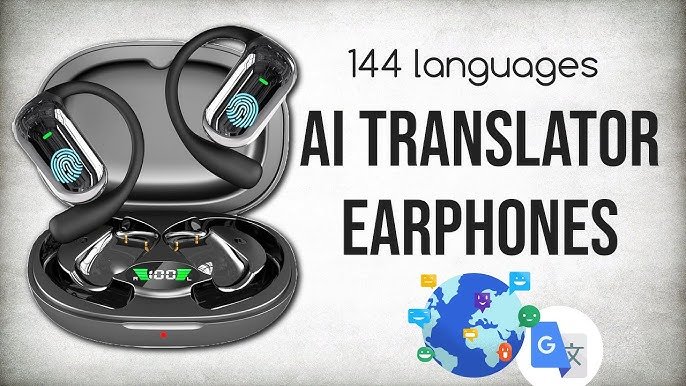
Introduction: The World Finally Speaks Your Language
Imagine landing in Tokyo, walking up to a local, and having a full conversation — in real time — without ever opening a translation app. No awkward pauses. No fumbling with your phone. Just natural, fluid communication.
That is exactly what AI translator headphones make possible today.
Whether you are a frequent traveler, a business professional closing deals across borders, or a student studying abroad, these smart devices are quietly changing the way humans connect. And in 2026, they have become smarter, faster, and more affordable than ever before.
This guide covers everything you need to know — how they work, which features matter, the top models worth buying, and how to pick the right pair for your lifestyle.
What Are AI Translator Headphones?
AI translator headphones are wireless earbuds or over-ear headphones embedded with artificial intelligence that can translate spoken language in real time. Unlike traditional translation tools that require you to type or tap a screen, these headphones listen, process, and deliver translated audio directly into your ear — often within one to three seconds.
They combine several cutting-edge technologies:
- Natural Language Processing (NLP) to understand context, slang, and sentence structure
- Speech Recognition to accurately capture spoken words even in noisy environments
- Machine Learning models trained on billions of multilingual conversations
- Bluetooth and cloud connectivity to process translations at high speed
The result is a seamless, hands-free translation experience that feels remarkably close to having a personal interpreter in your ear.
How Do AI Translator Headphones Actually Work?
Understanding the process helps you set realistic expectations and choose the right product.
Step-by-Step Translation Flow
- You or your conversation partner speakhttps://ddstep.in/ai-image-enhancer-the-smartest-way-to-transform-your-photos-in-2026/s — the headphone’s microphone picks up the audio.
- Speech-to-text conversion happens almost instantly, either on-device or via the cloud.
- The AI translates the transcribed text into the target language using NLP models.
- Text-to-speech synthesis converts the translation back into natural-sounding audio.
- The translated audio plays in your ear within one to three seconds.
Some premium models support simultaneous translation, meaning they translate while you are still speaking, not after you finish. This makes conversations feel shockingly natural.
Online vs. Offline Translation
Most AI translator headphones rely on a cloud connection for the best accuracy. However, leading models now include offline mode for commonly spoken languages like English, Spanish, Mandarin, French, and Hindi — a crucial feature when traveling in areas with poor connectivity.
Top Features to Look for in AI Translator Headphones
Not all AI translator headphones are created equal. Here is what separates a great pair from a mediocre one.
1. Language Support
The best devices support 40 to 100+ languages. Make sure your target language is supported with strong accuracy, not just basic coverage. Languages like Arabic, Japanese, and regional dialects often vary widely in quality between brands.
2. Translation Speed and Latency
Latency matters enormously in conversation. Look for headphones with under 3 seconds of delay. Anything beyond that disrupts the natural rhythm of a conversation and makes interaction feel clunky.
3. Noise Cancellation
Background noise is the enemy of accurate translation. Active Noise Cancellation (ANC) paired with smart microphone arrays ensures the AI captures your voice clearly — whether you are in a busy airport, a crowded market, or a conference room.
4. Two-Way Translation
Some budget devices only translate one direction (for the wearer). True bidirectional translation means both speakers can communicate — one speaks into the headphone, the other into a companion app or second earbud.
5. Battery Life
Long conversations need long battery life. Aim for at least 6 to 8 hours of active translation on a single charge, with a charging case providing additional backup.
6. On-Device (Offline) Mode
Essential for international travelers. Without offline capability, a dead Wi-Fi zone can leave you completely stuck mid-conversation.
7. Companion App Quality
The mobile app controls language selection, updates AI models, and often displays text transcripts. A clean, intuitive app significantly improves the overall experience.
Best AI Translator Headphones in 2026
Here is a look at standout options across different price ranges and use cases.
Best Overall: Timekettle WT2 Edge
The Timekettle WT2 Edge remains a top-tier choice for real conversations. It supports 40 languages and 93 accents, offers simultaneous translation with under 1.5 seconds of latency, and features a comfortable in-ear design for both conversation partners. The companion app is polished, and offline support covers the most common global languages.
Best for: Travelers and professionals who need hands-free, two-way conversation support.
Best Premium Option: Google Pixel Buds Pro 2
Google’s deep investment in AI language models gives the Pixel Buds Pro 2 a major translation edge. Integrated tightly with Google Translate’s neural engine, these earbuds offer real-time translation that feels natural in casual conversation. They also deliver exceptional ANC and audio quality, making them a dual-purpose powerhouse.
Best for: Android users who want premium audio and seamless Google ecosystem integration.
Best Budget Pick: Wearbuds Translate Lite
For travelers on a budget, this model punches well above its price point. It supports over 30 languages, offers decent offline coverage, and the companion app is straightforward. Translation speed is slightly slower at 2.5 to 3 seconds, but for casual travel use, it more than delivers.
Best for: First-time users and casual travelers who want solid performance without a heavy investment.
Practical Tips for Getting the Most from Your AI Translator Headphones
Owning the right pair is only half the battle. These tips will help you maximize accuracy and comfort.
Speak Clearly and at a Moderate Pace
AI translation models perform best when speakers enunciate clearly. Avoid rushing. Short, clear sentences produce better results than long, complex ones loaded with idioms or industry jargon.
Pre-Select Languages Before a Conversation
Do not scramble with settings mid-conversation. Open your companion app before you arrive and set both the input and output languages in advance.
Use Offline Mode in Low-Connectivity Zones
Download your most-used language packs before traveling to a new country. This ensures you are never caught without translation support in rural areas or during flights.
Position the Microphone Correctly
Many users overlook this. The microphone needs to be close to the speaker’s mouth. Ensure your fit is snug and the mic is not obstructed by clothing or hair, especially outdoors.
Keep the App Updated
AI translation models improve constantly. Regular app updates deliver better accuracy, new language support, and reduced latency. Set your app to auto-update.
Test in Noisy Environments First
Before a critical conversation — a business meeting, a medical appointment, a legal interaction — test your headphones in a noise environment similar to where you will use them. This helps you calibrate expectations and troubleshoot early.
AI Translator Headphones for Business vs. Travel: Key Differences
The use case shapes which features matter most.
For Business Professionals
- Prioritize simultaneous translation to avoid interrupting speaking flow in meetings
- Look for transcript logging via the companion app for post-meeting review
- Noise cancellation is critical for conference room environments
- Discretion matters — choose models with minimal visual bulk
For Travelers
- Offline language packs are non-negotiable
- Bidirectional translation lets locals respond naturally
- Battery life is more important than for short business meetings
- Lightweight, comfortable design for all-day wear matters more
Common Misconceptions About AI Translator Headphones
Let us clear up a few myths that hold people back from trying this technology.
“They are only for fluent speakers trying to polish their language.”
False. These headphones are designed precisely for people with zero knowledge of a foreign language. You do not need any prior language skills.
“The translation is always robotic and unnatural.”
In 2026, top-tier models use neural TTS (Text-to-Speech) that sounds close to a human voice. The gap between robotic and natural has closed dramatically.
“They only work in quiet rooms.”
Modern noise-cancelling microphone arrays handle environments as loud as busy train stations with impressive accuracy.
“They are too expensive for casual use.”
Budget options now start under $80, making them accessible to nearly anyone who travels occasionally.
The Future of AI Translator Headphones
The trajectory of this technology points to something remarkable. Within the next few years, we can expect:
- Sub-second simultaneous translation that eliminates any noticeable delay
- Emotion and tone detection that adapts translation style to context — formal vs. casual, confident vs. uncertain
- Augmented reality integration combining audio translation with real-time visual text overlays
- Expanded dialect support covering regional speech patterns that current models still struggle with
As AI language models grow more capable and on-device processing becomes more powerful, the line between speaking with someone in your own language and theirs will effectively disappear.
Conclusion: Your Language Barrier Ends Here
AI translator headphones are no longer a futuristic novelty — they are practical, powerful tools that belong in every traveler’s bag and every global professional’s toolkit.
They will not make you fluent in Mandarin overnight. But they will let you connect, negotiate, explore, and build relationships across language lines that would otherwise remain closed.
If you have been hesitant, now is the right time. The technology is mature, the prices are reasonable, and the use cases are limitless.