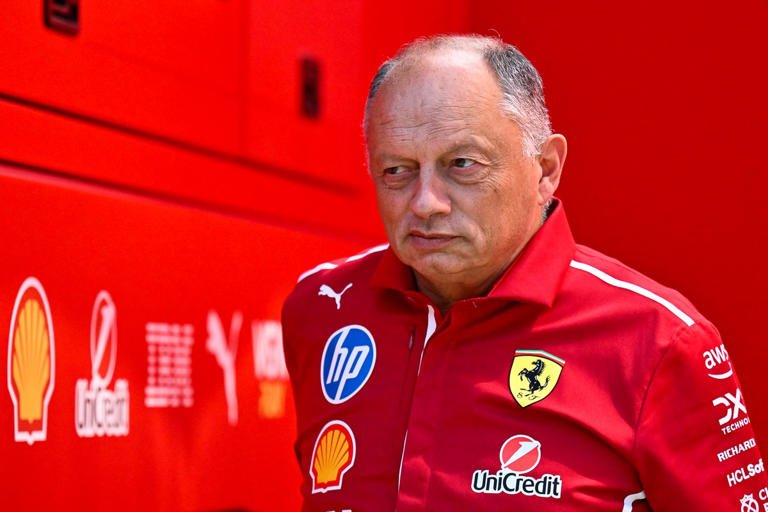
Formula 1’s 2026 season was always going to be controversial. New cars, new engines, new rules — change at this scale never comes without friction. But nobody predicted the paddock would erupt into open warfare quite this fast.
After just two races, the sport’s biggest names are trading public insults, regulatory complaints are stacking up like traffic at a safety car restart, and Ferrari team principal Fred Vasseur has had enough.
Speaking to media after the Chinese Grand Prix, Vasseur was direct and unflinching: “I think that we already massively changed the rules of the start with the five-second sequence. One year ago, I went to the FIA, raised my hand on the starting procedure. I said: ‘Guys, it will be difficult.’ The reply was clear: that you have to design the car to fit with the regulations, not change the regulations to fit with the car. We designed the car to fit the regulations. The change with the five-second blue light sequence didn’t help us at all. But at some stage, enough is enough.” Wikipedia
That statement — blunt, justified, and clearly fed up — captures everything that is currently boiling over in the 2026 Formula 1 paddock. And to understand why it matters, you need to understand the three-layer controversy that produced it.
The Race Start Controversy: Why Ferrari Has a Massive Advantage Off the Line
What Is Happening at Race Starts in 2026?
It emerged in pre-season testing that the challenges of getting the 2026 cars off the line were pretty extreme — with many cars needing a 10-second window to spool up the turbos. The inconsistent nature of launches pushed drivers to get the FIA to change the procedure for when cars had formed up on the grid, which resulted in the new extended five-second pre-start window. Inc
The new 2026 power units — featuring a near 50-50 split between internal combustion and electrical power — have made race starts significantly more complex than in previous seasons. The energy management required to launch a car cleanly from a standing start has proven to be a major engineering challenge for most of the field.
Most of the field. Not Ferrari.
The Italian team’s lightning starts in races have been a feature of the first two weekends of the sport’s new rules era, with Charles Leclerc taking the lead in Australia and Lewis Hamilton doing likewise in China from the second row of the grid. CNN
Both drivers started behind the front row Mercedes of George Russell — and both drove into the lead by Turn One. The physics of that achievement, repeated across two races and two continents, is not luck. It is engineering.
Why Ferrari’s Power Unit Gives It a Structural Start Advantage
The smaller turbo in the Italian manufacturer’s power unit allows it to be spooled up to the correct RPM more easily and consistently, in turn helping produce more effective and reliable launches off the line. Ferrari identified the issue its rivals are currently facing a year ago, and when it brought its concerns to the FIA, it was waved away. So the Scuderia adapted and created a power unit that could handle the rigours of race starts. Wikipedia
This is the heart of Vasseur’s frustration — and the reason his “enough is enough” statement carries such moral force. Ferrari went to the FIA in 2025 and raised the flag. It was told to adapt its car. It spent months and millions doing exactly that. And now, when the benefit of that work shows up on track, rivals are demanding the rules be changed again.
George Russell Calls Ferrari “Selfish” — and Vasseur Fires Back
Mercedes’ championship leader George Russell insisted before the race in Shanghai that Ferrari were being “selfish” for blocking a tweak to the procedure, which has already been modified with a five-second ‘flashing blue light’ to allow time for the drivers at the back to minimise their turbo lag. CNN
Russell’s comments — calling out a rival team by implication in a pre-race press conference — were provocative by any measure. Vasseur was not going to let them pass.
Ferrari has emerged as a key lobbyist for keeping things as they are because it is an area of significance in its performance battle with Mercedes. Right now, Ferrari’s better starts are proving decisive in helping it get to the front off the line even when it has qualified behind. Inc
The subtext of Vasseur’s response is clear: Mercedes has the faster car on most of the lap. Ferrari has the better start. Asking Ferrari to give up its start advantage while Mercedes keeps its straight-line speed advantage is not fairness. It is competitive convenience dressed up as a safety concern.
The Engine Controversy: Mercedes’ Compression Ratio “Loophole” Explained
The race start dispute is just one layer of the 2026 Ferrari-Mercedes conflict. The deeper and potentially more consequential fight is over Mercedes’ engine.
What Is the Compression Ratio Trick?
Mercedes is understood to have found a way to comply with the testing requirement to hit the 16:1 ratio limit when the engine is measured in ambient conditions, but run at a higher level when its power unit is at hot operating temperatures. PBS
In simpler terms: the rules say engines must have a compression ratio of no more than 16:1. Mercedes’ engine meets that limit — when it is cold and sitting in the pit lane. But when it is running at full operating temperature on the circuit, it runs at a higher compression ratio of approximately 18:1, generating significantly more power.
Ferrari are unhappy that Mercedes have read the wording of the 2026 F1 engine regulations in such a way that allows their rate of compression to rise in excess of 16:1 during operation as it could be worth as much as four-tenths of a second a lap, depending on the track layout. Al Jazeera
Four-tenths of a second per lap is not a marginal gain. It is a race-deciding advantage over a season.
Who Is on Which Side?
Ferrari, Audi, and Honda are leading a challenge to change the measuring requirements to when the engines are running hot, with Mercedes firmly against. The swing vote among the teams is Red Bull Powertrains, which is believed to have swung its backing behind the former trio. euronews
Red Bull, Ferrari, Audi and Honda should protest the Mercedes power unit if they are so unhappy with its clever compression ratio trick, says Alpine managing director Steve Nielsen. NBC News Alpine — now a Mercedes customer team — has every commercial interest in keeping the current rules intact, which makes Nielsen’s challenge to rivals to “put some skin in the game” somewhat self-serving. But it underlines how divided the paddock has become.
What Did the FIA Decide?
Mercedes’ manufacturer rivals came together and managed to push through rules amendments that will clamp down on compression ratio tricks. From June 1, measurements of the 16:1 limit will be taken when power units are both cold and hot — while from the start of 2027, compliance will only be taken from the higher temperature reference. Inc
Crucially, Mercedes is adamant that its current power unit will have no problem passing the new June 1 compliance checks, and will not lose any performance as a result. Its rivals are not convinced. Inc
Ferrari’s response? Build their own version. Plans are already in place in Maranello for the Scuderia to now mimic the engine trick themselves. Enrico Gualtieri, the technical director of Ferrari’s engine division, has given the green light for their engineers to develop “substantial modifications” for their power unit, with the goal of creating a dynamic compression ratio. Al Jazeera
Toto Wolff’s Response: “Just Get Your S— Together”
Mercedes team principal Toto Wolff has not been conciliatory. When asked about rivals’ complaints regarding the compression ratio, his response was characteristically blunt — telling Ferrari, Honda, and Audi to “just get your s— together” and suggesting they might just be “finding excuses.”
That kind of language in a paddock where teams need to cooperate on governance, safety standards, and future regulations is itself a sign of how heated this rivalry has become.
The Performance Picture: Mercedes Is Still Winning — For Now
The First Two Races: Mercedes’ Dominance Despite Ferrari’s Starts
Here is the competitive paradox at the heart of the 2026 season: Ferrari is out-starting Mercedes at every race so far. And Mercedes is still winning every race so far.
Despite Ferrari’s lightning starts, Mercedes have won the opening two grands prix, with Kimi Antonelli claiming his first-ever F1 win in China after Russell’s season-opening victory in Melbourne. CNN
The Silver Arrows clearly have the most crucial advantage in extra power via their engine, most notably seen on the back straight in China in which they made up around half a second a lap on their rivals. CNN
Half a second per lap on the straight alone. That is the Mercedes engine advantage in practice — and it is what Ferrari is trying to close through both technical development and regulatory pressure.
Ferrari Acknowledges the Gap — and Is Closing It
Vasseur was candid about where his team stands. On where Ferrari are trailing Mercedes, Vasseur said: “We know that we have a deficit of performance, mainly in the straight line. We have to work on it. We are improving because we were eight tenths off in Melbourne, six tenths on Friday in China, four tenths on Saturday. Step by step we are understanding a bit more the situation and closing the gap, but they are still far away.” CNN
The trajectory — from 0.8 seconds behind to 0.4 seconds behind in the space of one race weekend — is encouraging for Ferrari fans. The gap remaining is still large. But this is exactly the kind of structured, week-on-week improvement that championship campaigns are built on.
What Comes Next: The Regulation Battles That Will Define the Season
The Post-Suzuka Technical Meeting
As revealed by The Race, a meeting of technical chiefs will take place in the fortnight after Suzuka to evaluate tweaks to the regulations that can iron out areas of concern from the Miami Grand Prix at the start of May. The energy management levels are likely to be the central focus, with debate raging about how to find ways to improve harvesting efficiencies and allow for better deployment tactics that do not leave cars struggling for power. Inc
This meeting will be one of the most consequential in recent F1 history. Any changes to energy management rules will directly affect the competitive order — and every team in the paddock knows it. Expect intense lobbying, carefully worded position papers, and more public statements from Vasseur, Wolff, and others in the weeks leading up to it.
The June 1 Engine Test: The Real Verdict on the Mercedes Trick
The June 1 hot-temperature compression ratio test is the next major regulatory flashpoint. Mercedes insists it will pass without losing performance. Rivals insist it cannot. Someone will be wrong — and the answer will reshape the championship standings for the rest of the year.
A change in the testing rules comes into force from June 1 — following what will now be the season’s fifth round due to the cancellations of April’s Bahrain and Saudi Arabian Grands Prix — when engines will be tested both in hot and cold conditions. Vasseur played down the impact that change will have, but did suggest Ferrari were in line to benefit from another new rule in place for 2026 regarding in-season upgrades to power units. CNN
The Active Aerodynamics Arms Race
Beyond engines and starts, there is a third technical battleground developing: active aerodynamics. Ferrari were among the teams who pushed for changes to tests over engine compression ratio limits after feeling Mercedes had exploited a loophole in the regulations. CNN The active aero systems — where drivers lower wing angles to reduce drag on straights — are adding another layer of complexity to the energy management debate that the post-Suzuka meeting will need to address.
How to Follow the Ferrari-Mercedes War All Season
For fans — especially new US viewers arriving via Apple TV — understanding the Ferrari-Mercedes rivalry is the key to getting the most from the 2026 season. Here is your practical guide:
- Watch every qualifying session — the start advantage Ferrari has means grid position is less decisive than ever, making qualifying strategy more complex and interesting than the starting grid suggests
- Focus on straight-line speed comparisons — the back-straight speed trap data at every race tells you exactly how the engine gap between Ferrari and Mercedes is evolving
- Track the engine development tokens — both teams will introduce power unit upgrades across the season; when they come and what they deliver will shift the championship picture
- Follow the regulatory news closely — the June 1 engine compliance test and the post-Suzuka technical meeting are the two events most likely to change the competitive order before summer
- Watch for the Ferrari compression ratio upgrade — when Maranello’s “substantial modifications” reach the track, it will be a decisive moment in the title fight
- Monitor Antonelli’s development — Kimi Antonelli’s China victory was the story of the race weekend; whether the rookie can sustain that level across the season could be the defining subplot of 2026
Conclusion: A War With Layers — and It’s Only Race Two
Fred Vasseur’s “enough is enough” statement is more than a soundbite. It is the public face of a multi-front regulatory and competitive war that will define the 2026 Formula 1 season from Melbourne to Abu Dhabi.
Ferrari planned ahead, adapted its car, and built a start advantage that is the only thing keeping it competitive against Mercedes’ superior straight-line speed. When rivals demand that advantage be legislated away, of course the team principal pushes back.
Ferrari identified the issue its rivals are currently facing a year ago, and when it brought its concerns to the FIA, it was waved away. So the Scuderia adapted and created a power unit that could handle the rigours of race starts. Wikipedia
That is not selfishness. That is engineering. And in Formula 1, there is no higher compliment.
Mercedes has the engine. Ferrari has the starts. The FIA has the rulebook. And somewhere in the intersection of those three things, the 2026 world championship will be decided.
The Ferrari-Mercedes war is the story of this season. It is complex, technical, political, and — at its heart — genuinely gripping. Do not look away.