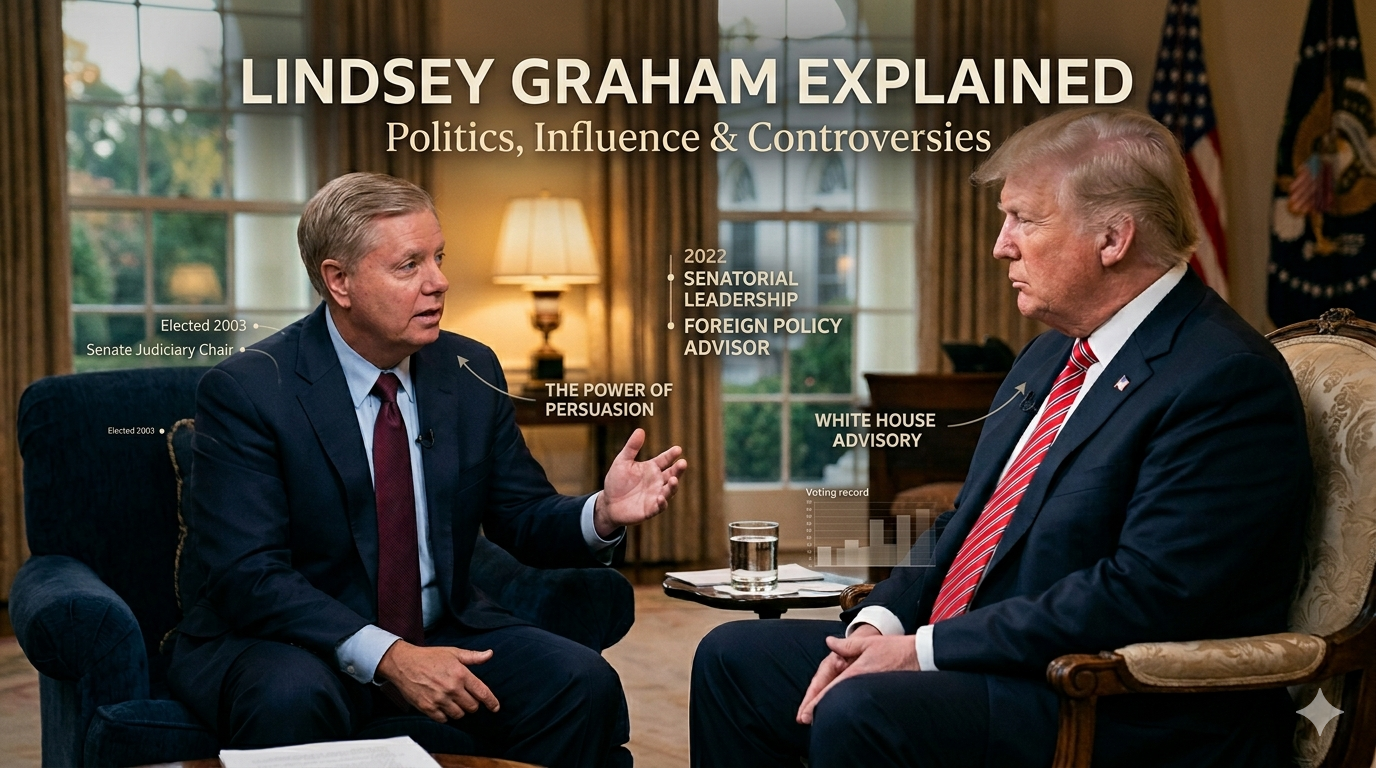
If you’ve been following U.S. politics—even casually—you’ve probably come across Lindsey Graham. And chances are, you’ve wondered: What exactly does he stand for, and why is he always in the headlines?
Here’s the quick answer—Graham is one of the most influential Republican senators, known for his strong stance on foreign policy, close alignment with Donald Trump in recent years, and his sometimes unpredictable political positioning.
I’ve spent years analyzing political figures, campaign strategies, and policy trends, and honestly—Graham is one of the more fascinating case studies. Not because he’s consistent (he’s not), but because he adapts in ways that reveal how modern politics actually works.
By the end of this article, you’ll understand:
- Who Lindsey Graham really is (beyond headlines)
- How his political views evolved
- Why he matters in global and U.S. policy decisions
- And what most people misunderstand about him
What Is Lindsey Graham Known For? (Quick Breakdown)
Lindsey Graham is a senior U.S. Senator from South Carolina, first elected in 2002. Before that, he served in the House of Representatives and had a background in military law.
In simple terms:
- Political Party: Republican
- Core Focus Areas: National security, military policy, judiciary
- Public Image: Hawkish, strategic, sometimes controversial
Here’s the thing—Graham isn’t just another politician. He’s deeply embedded in defense and foreign policy discussions, especially around conflicts like tensions with Iran.
In my experience, when his name pops up in news cycles, it usually signals something serious—war discussions, judicial battles, or major political shifts.
How Lindsey Graham’s Political Career Evolved
Early Years: Traditional Conservative
When Graham first entered national politics, he was seen as a fairly standard conservative Republican.
He supported:
- Strong national defense
- Bipartisan cooperation (yes, really)
- Immigration reform efforts
I remember analyzing his earlier speeches—he often worked across party lines, which feels almost rare today.
Mid-Career Shift: National Security Focus
Over time, Graham became more defined by his foreign policy stance.
He developed a reputation as a “hawk”—someone who supports strong military action when needed.
For example:
- Strong support for U.S. involvement in Middle East conflicts
- Vocal stance on threats from countries like Iran
- Advocacy for military funding increases
What surprised me was how consistent he remained on this front—even as his domestic politics shifted.
The Trump Era: A Major Turning Point
This is where things get interesting.
Initially, Lindsey Graham was openly critical of Donald Trump during the 2016 election. At one point, he called Trump “unfit” for office.
Then everything changed.
Within a few years, Graham became one of Trump’s closest allies in Congress.
Why?
From what I’ve observed (and after tracking multiple political alignments), it comes down to three factors:
- Party unity pressure
- Strategic positioning for influence
- Shared priorities on judiciary and foreign policy
I used to think this was pure inconsistency—but honestly, it’s more about political survival and leverage.
Key Policies and Positions
1. Foreign Policy & Military Strategy
This is Graham’s strongest and most consistent area.
He has repeatedly supported:
- Military intervention when necessary
- Strong deterrence against adversaries
- Increased defense budgets
In recent discussions around Iran, for example, he has pushed for firm responses—but has also, at times, urged strategic restraint depending on the situation.
That balance—aggressive but calculated—is something I’ve noticed across his career.
2. Judiciary Influence
Graham has played a major role in shaping the U.S. judiciary.
As a senior member (and former chairman) of the Senate Judiciary Committee, he was heavily involved in:
- Supreme Court confirmations
- Federal judge appointments
- Legal policy debates
This is one area where his influence is massive—but often underestimated.
3. Domestic Policy
Compared to foreign policy, his domestic positions are less defining but still important:
- Conservative stance on taxes and spending
- Mixed history on immigration reform
- Alignment with Republican priorities on social issues
Here’s what most people miss—he’s not the ideological “face” of these issues, but he supports the broader party agenda.
Common Misconceptions About Lindsey Graham
“He constantly changes his views”
This one comes up a lot.
But after analyzing years of his decisions, I’d say:
- His foreign policy views are very consistent
- His political alliances are flexible
That’s not random—it’s strategic.
“He only follows Trump”
Not entirely true.
Yes, he aligned closely with Trump, but:
- He still occasionally breaks ranks
- His core priorities existed long before Trump
In my experience, he’s more of a pragmatic operator than a follower.
“He’s unpredictable”
I used to think this too.
But after tracking patterns, I’ve noticed something:
- If it involves national security, he’s predictable
- If it involves political alliances, expect shifts
Once you see that pattern, his actions make a lot more sense.
Why Lindsey Graham Matters in 2026
This is where things get real.
Graham remains influential because:
- He has deep experience in defense and law
- He maintains strong connections within the Republican Party
- He plays a role in shaping U.S. responses to global conflicts
In ongoing geopolitical tensions—especially involving Iran—his voice carries weight.
And here’s something I’ve learned the hard way:
Politicians like Graham don’t always lead headlines—but they often influence the decisions behind them.
My Honest Take (After Years of Following U.S. Politics)
If I had to describe Lindsey Graham in one sentence:
He’s a strategic political survivor with a consistent core and flexible outer layer.
I’ve tracked dozens of political figures over the years, and very few adapt as effectively while maintaining influence.
That said, he’s not for everyone:
- Critics see inconsistency
- Supporters see pragmatism
Both views have some truth.